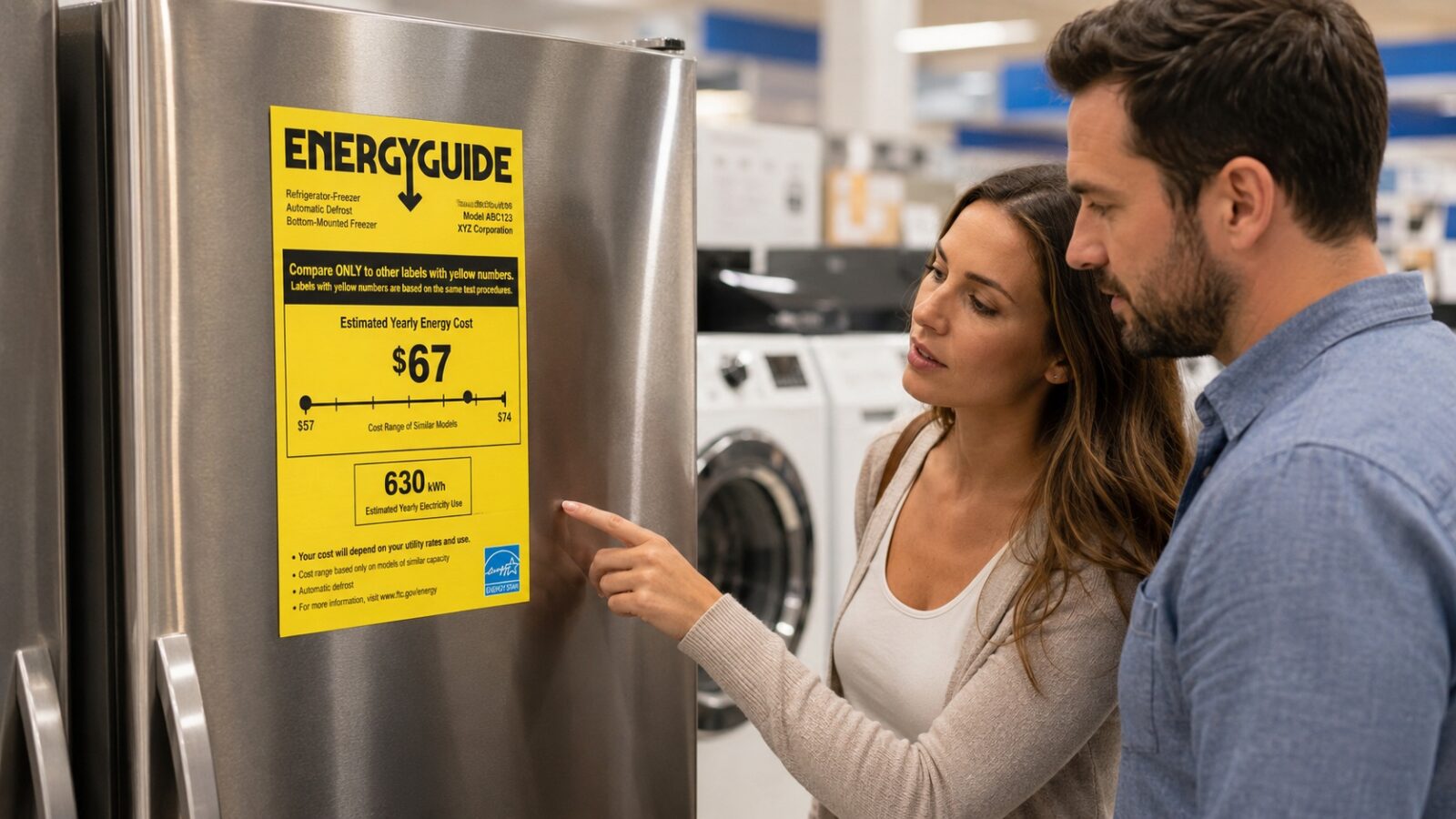
The yellow EnergyGuide label turns a vague promise such as “efficient” into numbers that can be compared. It does not tell you which appliance is best overall, and it does not predict your exact electricity bill. It gives a standard estimate so similar models can be judged on the same basis.
Find the product category first
Compare only appliances of a similar type and size. A large French door refrigerator should not be judged against a compact top freezer model, even if both labels show annual energy use. Capacity, configuration and features affect consumption.
Shortlist appliances that fit the space and household before using the label to separate efficient from inefficient models. The refrigerator buying guide covers dimensions, door clearance and layout before energy use enters the decision.
The estimated yearly operating cost
The prominent cost figure is based on a standard energy price and test procedure. It is useful for comparison, but your actual cost depends on local utility rates, climate, settings and use.
To make the number more personal, look at the label’s annual energy consumption and multiply it by the electricity price shown on your bill. Use the same rate for every model being compared.
The comparison range
The scale shows how the model sits among similar products, from lower estimated cost to higher estimated cost. Check the description of the comparison group carefully. A product near the low end of its group may still use more energy than a smaller or simpler appliance.
Do not treat a position on the scale as a quality score. The label does not rate noise, reliability, repairability, temperature consistency or ease of use.
Annual energy use
The energy consumption figure, commonly shown in kilowatt hours per year, is often the most useful part of the label. Unlike the estimated cost, it can be recalculated using your current tariff.
When comparing two models, subtract the lower annual energy use from the higher figure. Multiply the difference by your electricity rate, then consider how many years you expect to own the appliance. This shows whether a higher purchase price is likely to be recovered through lower running costs.
ENERGY STAR and EnergyGuide are not the same thing
EnergyGuide provides standardised information for comparison. ENERGY STAR is a separate efficiency certification for products that meet program requirements. A product may display both.
Use the EnergyGuide numbers to compare shortlisted models even when several carry the same certification. Efficiency can still vary within a certified group.
A simple comparison example
Imagine two similar refrigerators. Model A uses 430 kilowatt hours per year and Model B uses 350. The difference is 80 kilowatt hours annually. Multiply 80 by the electricity rate on your bill to estimate the annual running cost difference.
Then compare that saving with the purchase price, warranty, storage layout and expected ownership period. A small annual saving may not justify a model that is too narrow for the household or difficult to repair.
Look beyond the label
- Capacity: unused refrigerated space still consumes energy.
- Installation: poor ventilation and incorrect clearances can affect performance.
- Settings: excessively cold settings add energy use without improving food quality.
- Maintenance: blocked vents, dirty coils where accessible and damaged seals can reduce efficiency.
- Use pattern: frequent door opening, large hot loads and climate conditions change real consumption.
For washers and dryers
Energy is only part of the running cost. Water use, load capacity, cycle time and the moisture left in clothing can affect the overall household expense. A washer that extracts more water may reduce dryer time. The washer and dryer guide covers these trade offs.
For room air conditioners and heating equipment
Climate and sizing become especially important. An oversized unit can cycle poorly, while an undersized one may run continuously. Use professional sizing guidance where required rather than choosing only by the lowest annual cost estimate.
Take a photograph before leaving the shop
Photograph the EnergyGuide labels of the final choices. This makes it easier to compare numbers at home without relying on memory or marketing descriptions. For online purchases, retailers selling covered products should make label information available.
Use the label as one part of the decision
The EnergyGuide label is most valuable after size, function and installation needs are clear. It helps estimate the cost of ownership, but it cannot compensate for an appliance that does not fit the room or the household.