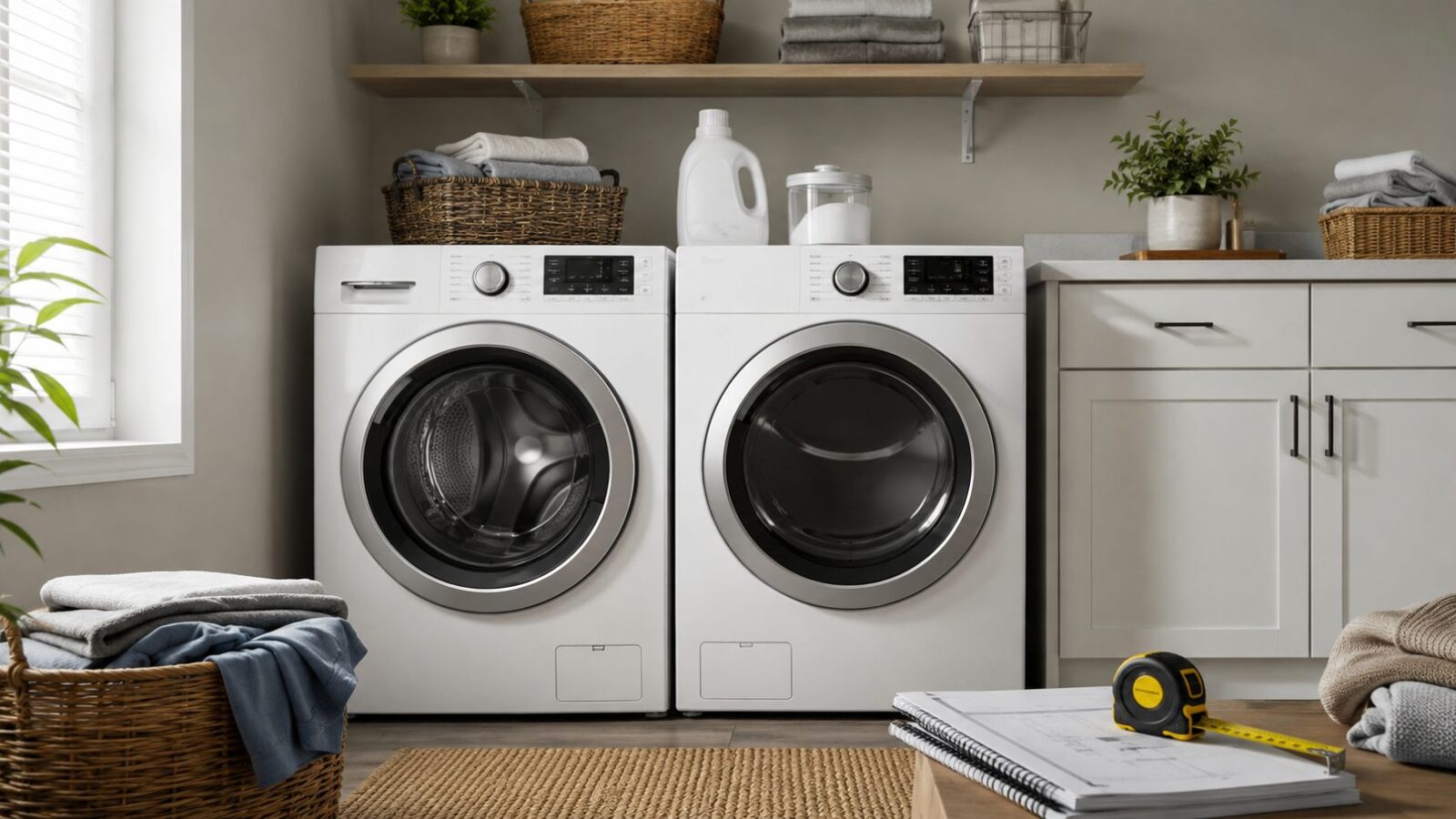
A washer and dryer are appliances you buy roughly once a decade and then interact with several times a week for the next ten or fifteen years. Like a refrigerator, they are infrastructure rather than gadgets, and the cost of choosing badly is a daily annoyance that compounds over years. The choices are not complicated, but they are easy to get wrong if you walk into a showroom and react to features. Decide the type, the configuration, and the size first, then let efficiency and a short list of genuinely useful features finish the job.
Start, as with any large appliance, by measuring the space and the path to it, including doorways and any stairs. A machine that will not fit is the most expensive mistake of all.
Front-load or top-load?
Front-load washers
Generally the most efficient and gentlest on clothes, using less water and spinning faster so less drying is needed. They can be stacked with a dryer to save floor space. The downsides are a higher price, a need to leave the door open to prevent odor, and a tougher reach for anyone with mobility issues.
Top-load washers
Easier to load without bending, often cheaper, and quicker per cycle. Agitator models clean aggressively but are harder on fabrics; high-efficiency impeller models are gentler and use less water. They cannot be stacked, so they need more floor space.
Configuration for your space
- Side-by-side: the standard when you have the floor width; easiest to use and service.
- Stacked: front-loaders stacked vertically, ideal for closets and tight laundry nooks.
- Laundry center: a single combined unit, compact but with smaller capacities.
- All-in-one washer-dryer: washes and dries in one drum, perfect for apartments with no venting, though drying is slower and capacity is limited.
Size it to your laundry, not the showroom
Washer capacity is measured in cubic feet, and bigger is not automatically better. A compact 2 to 3 cubic foot machine suits a couple or a small space; a standard 4 to 5 cubic foot drum handles a family and bulky items like bedding in one load. Crucially, match the dryer capacity to the washer so a full wash load fits in the dryer without cramming. Oversizing wastes energy and money on loads you rarely run, while undersizing means endless extra cycles.
Efficiency and features that matter
Because these machines run for years, efficiency is the headline that pays you back, the same long-run math behind choosing an efficient air purifier or refrigerator. Look for a strong energy and water rating first. Beyond that, a few features genuinely improve laundry life:
- A fast or high spin speed, which removes more water and shortens drying time.
- Steam cycles, useful for refreshing and reducing wrinkles if you hate ironing.
- A moisture sensor on the dryer, which stops automatically and prevents over-drying that wears out clothes.
- Quiet operation, which matters a lot if the laundry is near living or sleeping areas.
Skip the long menu of rarely used cycles and app connectivity unless they are free; most people use three or four cycles and ignore the rest.
Gas, electric, or heat-pump drying?
Dryers are not all the same under the hood, and the type affects both running cost and installation.
- Electric dryers are the most common, simple to install wherever there is a suitable outlet and venting.
- Gas dryers cost more upfront and need a gas line, but often run cheaper and dry faster where gas is inexpensive.
- Heat-pump dryers are ventless and highly efficient, ideal where venting is impossible, though they dry more slowly and cost more to buy.
- Any vented dryer needs a clear, short vent run; a long or clogged vent wastes energy and is a fire risk.
Match the dryer type to what your home can in practice accommodate before you fall for a feature, since venting and connections are not easily changed later.
Washer and dryer questions before installation
Are front-load or top-load washers better?
Front-loaders are generally more efficient, gentler on clothes, and stackable, but cost more and need the door left open to stay fresh. Top-loaders are cheaper and easier to load without bending. Choose based on space, budget, and mobility.
What capacity washer do I need?
A couple or small space is fine with 2 to 3 cubic feet; a family wants 4 to 5 to wash bedding and large loads in one go. Match the dryer capacity to the washer.
Is an all-in-one washer-dryer worth it?
For apartments with no dryer venting or very little space, yes. The trade-offs are smaller capacity and slower drying, so it suits small households rather than families.
How long should a washer and dryer last?
A quality washer and dryer typically last around ten to fifteen years with normal use and basic care. The biggest factors in reaching the upper end of that range are not overloading the machines, cleaning the lint filter every cycle, keeping the dryer vent clear, and leaving a front-loader’s door open between washes to prevent odor and seal damage. When repairs start approaching half the cost of a new machine, especially past the ten-year mark, replacement usually makes more sense than fixing, particularly given how much more efficient newer models tend to be.
Laundry room mistakes that add friction
- Buying before measuring the space, the doorways, and any venting requirements.
- Mismatching washer and dryer capacity so full loads will not fit the dryer.
- Oversizing for rare big loads and paying to run a half-empty machine for a decade.
- Ignoring the energy and water rating on appliances that run for years.
- Choosing a front-loader without planning to leave the door open, then fighting odor.
Plan around the loads you really wash
The most underrated factor in laundry satisfaction is spin speed, not the wash itself. A washer that spins fast leaves clothes far drier, which cuts dryer time, energy use, and wear on fabrics all at once. People obsess over wash cycles and overlook this single spec that quietly improves everything downstream. Buy efficient, match the capacities, measure the space honestly, and prioritize a strong spin. The rest of the feature list rarely changes your week. It also helps to buy the washer and dryer as a matched pair from the start, since mismatched capacities and styles cause more daily friction than any missing cycle, and a coordinated set stacks or sits side by side cleanly in the space you measured.
Choose laundry appliances in order: measure the space and venting, pick front-load or top-load to suit your needs, match the washer and dryer capacities to your real loads, and buy for efficiency and a strong spin speed. Ignore the cycle-count marketing, and you will get machines that quietly handle the laundry for the next decade without driving up your bills.