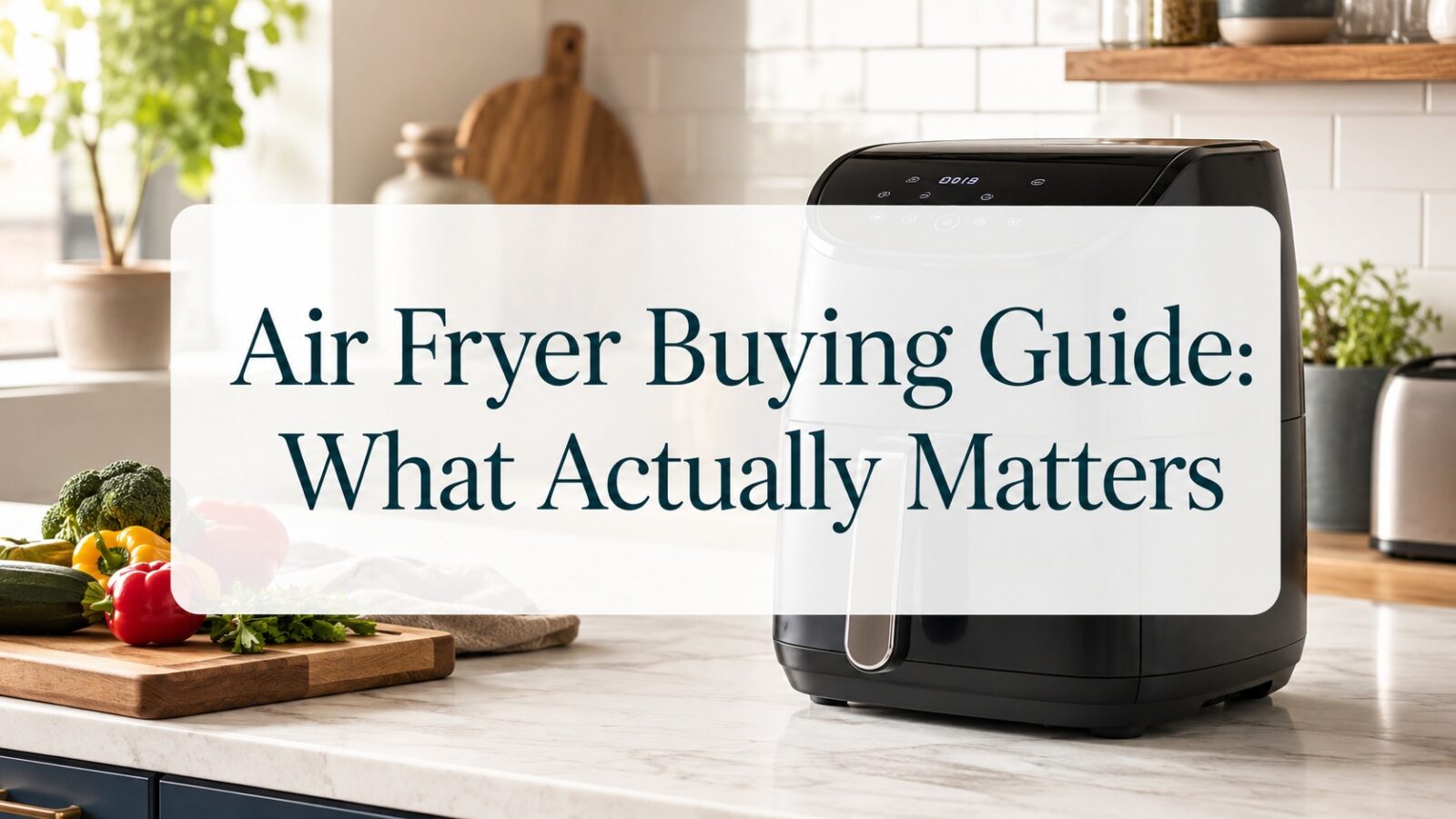
An air fryer is, mechanically, a small convection oven with a powerful fan and excellent marketing. That is not a knock; the format genuinely makes crisp food fast with little or no oil, and for many households it has quietly replaced the toaster oven and even the big oven for weeknight cooking. But the marketing has also spawned dozens of near-identical models with confusing specs and gimmick features. Once you understand what an air fryer in practice does, choosing one becomes simple, and you can ignore most of what the box is shouting about.
The questions that matter are capacity, type, and ease of cleaning. Almost everything else is noise.
Pick the right type
Basket air fryers
The classic drawer-style design. You pull out a basket, load it, and slide it back. Best for crisping, draining fat, and shaking food mid-cook. Compact and simple, though you usually cook in batches and cannot easily watch the food.
Oven-style air fryers
A countertop oven with an air-fry mode, racks, and a door. More versatile, with room for more food and the ability to toast, bake, and reheat, but bulkier and sometimes less aggressive at crisping than a basket. A strong choice if it can replace a toaster oven and reduce countertop clutter.
Dual-basket models
Two independent baskets that cook different foods at different settings and finish together. Excellent for families and full meals, at the cost of significant counter space.
Capacity is the decision most people get wrong
Capacity, measured in quarts, is where buyers most often misjudge. A small 2 to 3 quart basket suits one or two people but forces constant batch cooking for more. A 5 to 6 quart model is the versatile sweet spot for most households. Larger 8 quart and oven-style units handle families and whole meals but take up real estate. Buy for the number of people you usually cook for, remembering that basket capacity in quarts overstates how much food in practice fits in a single even layer.
Features worth paying for, and gimmicks to skip
- Worth it: dishwasher-safe, nonstick basket and tray, since cleaning is the chore that decides whether you keep using it.
- Worth it: a wide enough basket to spread food in one layer, which crisps far better than a deep pile.
- Worth it: simple, durable controls, whether dial or digital, that you will not fight with daily.
- Skip for most: dozens of preset cooking programs, which sound useful but go unused once you learn times.
- Skip for most: app connectivity, which adds cost and rarely changes how you cook.
Living with an air fryer
The appliances people keep on the counter are the ones that are easy to use and easy to clean, and the ones they hide away are the fussy ones. Factor the air fryer into your overall small-kitchen organization, since a bulky model that lives in a cupboard rarely gets used. It pairs well with the other genuinely useful countertop machines, like a good coffee maker, and it handles a lot of the quick cooking that otherwise needs the big oven. A sharp knife and a board for prep, covered in our kitchen knives guide, round out the setup.
How to get genuinely crispy results
The machine does most of the work, but a few habits separate crisp, golden food from pale, steamed disappointment.
- Do not overcrowd the basket; food needs space for air to circulate, so cook in a single layer.
- Shake or turn food partway through so all sides brown evenly.
- Pat wet foods dry and use a light spritz of oil to encourage browning.
- Preheat for a couple of minutes for anything you want crisp from the first second.
- Leave a little room rather than maxing the stated capacity, which is measured generously.
Follow those and the air fryer lives up to the marketing; ignore them and you will wonder what the fuss was about.
Features that sound better than they perform
- Buying too small and then cooking everything in frustrating batches.
- Overcrowding the basket, which steams food instead of crisping it.
- Choosing a model with parts that are not dishwasher safe, then using it less because cleanup is a chore.
- Paying for preset programs and connectivity you will never touch.
- Forgetting that a large unit needs permanent counter space to in practice get used.
Air fryer questions beyond capacity
What size air fryer should I buy?
For most households, a 5 to 6 quart model is the sweet spot. One or two people can manage with 3 to 4 quarts; families and whole-meal cooking want 8 quarts or a dual-basket or oven-style unit.
Is a basket or oven-style air fryer better?
Baskets crisp aggressively and are compact; oven-style units are more versatile and can replace a toaster oven. Choose a basket for pure crisping in a small kitchen, an oven-style if you want one appliance to do more.
Do air fryers in practice use no oil?
They need little or none because the hot circulating air crisps the surface. A light spritz of oil improves browning on some foods, but you use a fraction of what deep frying requires.
Can an air fryer replace my oven?
For one or two people and everyday cooking, it can handle a surprising amount: crisping, roasting vegetables, reheating leftovers far better than a microwave, and cooking small batches of almost anything quickly. What it cannot do is cook for a crowd or fit large dishes, since even a big air fryer holds far less than an oven. Many households end up using the air fryer for fast weeknight meals and the oven only for batch cooking and large roasts, which often means the big oven runs far less and the kitchen stays cooler in summer.
Capacity matters more than app controls
The biggest predictor of whether an air fryer earns its counter space is how annoying it is to clean. People imagine they will cook elaborate meals; in reality they reach for it on busy nights, and if washing the basket is a pain, it slowly migrates to a cupboard. Prioritize a dishwasher-safe basket and a size that fits your household in one layer, and ignore the long spec list. An air fryer you in practice use beats a feature-packed one you avoid.
Pay for cooking performance, not decoration
Treat the air fryer as the capable little convection oven it is, and the choice gets easy: pick the type that fits how you cook, size it to your household in a single layer, and prioritize a basket that goes in the dishwasher. Skip the preset programs and the app, and you will end up with a machine that in practice stays on the counter and earns its keep.