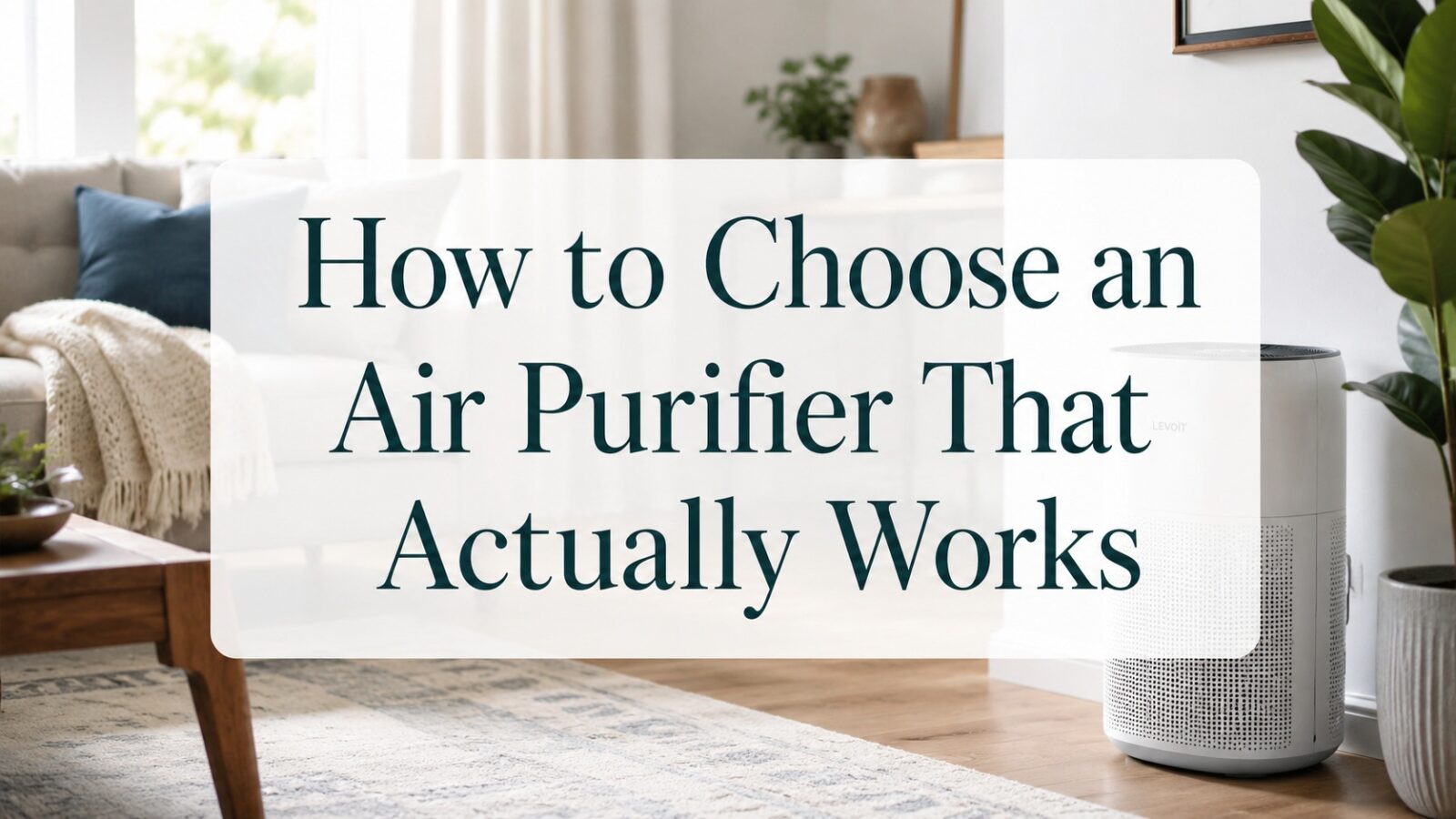
Air purifiers are a category drowning in marketing, vague health claims, and numbers designed to confuse. Strip it back and the question is simple: can the unit move enough clean air through the room you put it in? Two specifications answer that, and almost everything else on the box is noise. Unlike houseplants, which there are written about and which do very little for actual air quality, a properly sized purifier genuinely reduces dust, pollen, smoke, and other fine particles. Here is how to choose one that works rather than one that just hums in the corner.
Get the filter type and the room sizing right, and you have a purifier that does its job. Get either wrong and no amount of features will save it.
The filter is what matters most
The heart of any purifier is its filter, and for particles the standard worth looking for is a true HEPA filter, which captures the vast majority of fine airborne particles including dust, pollen, and smoke. Be wary of vague phrases like “HEPA-type” or “HEPA-like,” which signal a lesser filter. If odors and gases concern you, look for an activated carbon stage in addition to the HEPA filter, since carbon handles smells while HEPA handles particles. They do different jobs, and many good purifiers combine both.
Size it to the room
A purifier only works if it can clean the air in your actual room often enough, and this is where most people go wrong. The key number is the clean air delivery rate, which tells you how much filtered air the unit produces. Match that rating to your room size, and ideally choose a unit rated to clean the room several times an hour for meaningful results. A small purifier in a large room is just an expensive fan with a filter. When in doubt, size up, since running a larger unit on a low, quiet setting beats straining a small one at full blast.
Features worth paying for, and ones to skip
- Worth it: a genuine HEPA filter, and carbon too if odors matter to you.
- Worth it: a clean air delivery rate matched to or above your room size.
- Worth it: a quiet low setting, since a purifier you run constantly beats a loud one you switch off.
- Useful: a filter-change indicator and reasonably priced replacement filters.
- Skip for most: ionizers and ozone-generating modes, which can produce irritants and add little.
- Skip for most: app connectivity and air-quality displays, which are nice but not why it works.
Where to place it and how to run it
Placement and habits matter as much as the unit. Put the purifier in the room where you spend the most time, usually the bedroom or living room, with space around the intake and outflow rather than jammed against furniture. Run it continuously on a low setting rather than blasting it occasionally; steady filtering keeps particle levels down far better than bursts. Keep windows and doors closed while it runs for best effect, and remember that controlling sources, by reducing dust and not smoking indoors, makes the purifier’s job easier. The long-run cost is mostly filters, the same ongoing-cost thinking that applies to any major appliance.
Maintenance keeps it working
A purifier is only as good as its filter, and a neglected one quietly stops cleaning the air while still running. Upkeep is simple but essential.
- Replace the HEPA filter on the schedule the manufacturer recommends, since a clogged filter restricts airflow and loses effectiveness.
- Vacuum or replace any pre-filter regularly to catch large particles and extend the main filter’s life.
- Keep the intake and outflow vents clear of dust and obstructions.
- Factor replacement filters into the running cost before you buy, since cheap units sometimes use pricey filters.
A purifier with fresh filters and clear vents keeps doing its job; one left on the same filter for a year is mostly just moving air around.
Ignore almost everything on the box except the filter type and the clean air delivery rate relative to your room. Manufacturers love to advertise app control, mood lighting, and impressive-sounding modes, none of which determine whether your air in practice gets cleaner. A true HEPA filter, a unit sized generously for the room, and the discipline to run it quietly all the time will outperform a feature-packed purifier that is too small or too loud to use. Then just budget for filters and let it work. The unit that helps you is the one you in practice run, so quiet operation and affordable filters matter more in practice than any headline feature, because they are what keep it switched on day after day.
Air purifier claims that deserve caution
- Buying a unit too small for the room, so it never cleans the air often enough.
- Falling for “HEPA-type” wording instead of a true HEPA filter.
- Choosing a purifier so loud you end up turning it off.
- Forgetting the ongoing cost and availability of replacement filters.
- Relying on an ionizer or ozone mode, which can irritate airways and adds little real cleaning.
Choose clean air delivery for the real room
Choosing an air purifier comes down to two things: a true HEPA filter, plus carbon if odors matter, and a clean air delivery rate sized generously for your room. Place it where you spend the most time, run it quietly and continuously, and budget for replacement filters. Get those right and ignore the rest of the marketing, and you will have a purifier that measurably improves your air.
Air purifier questions about rooms and filters
What size air purifier do I need?
One whose clean air delivery rate matches or exceeds your room size, ideally able to clean the room several times an hour. When unsure, size up and run it on a lower, quieter setting.
Do air purifiers really work?
A properly sized unit with a true HEPA filter genuinely reduces airborne particles like dust, pollen, and smoke. The keys are a real HEPA filter and matching the unit’s capacity to the room.
Should I run my air purifier all the time?
Yes, ideally on a low, quiet setting. Continuous filtering keeps particle levels consistently low far better than running it intensely for short bursts.
Where is the best place to put an air purifier?
In the room where you spend the most time, typically the bedroom or the main living area, rather than a hallway or a corner no one uses. Give it space around the intake and outflow instead of jamming it against a wall or behind furniture, so air can circulate freely through it. Keeping the doors and windows of that room closed while it runs helps it clean the same air repeatedly rather than constantly fighting outdoor air, and a spot off the floor and away from obstructions generally improves how well it draws air in.