Stand mixer ranges look confusing because the differences are mostly mechanical rather than cosmetic. Once you understand tilt-head versus bowl-lift and how capacity relates to dough, the choice becomes straightforward.
Tilt-head versus bowl-lift
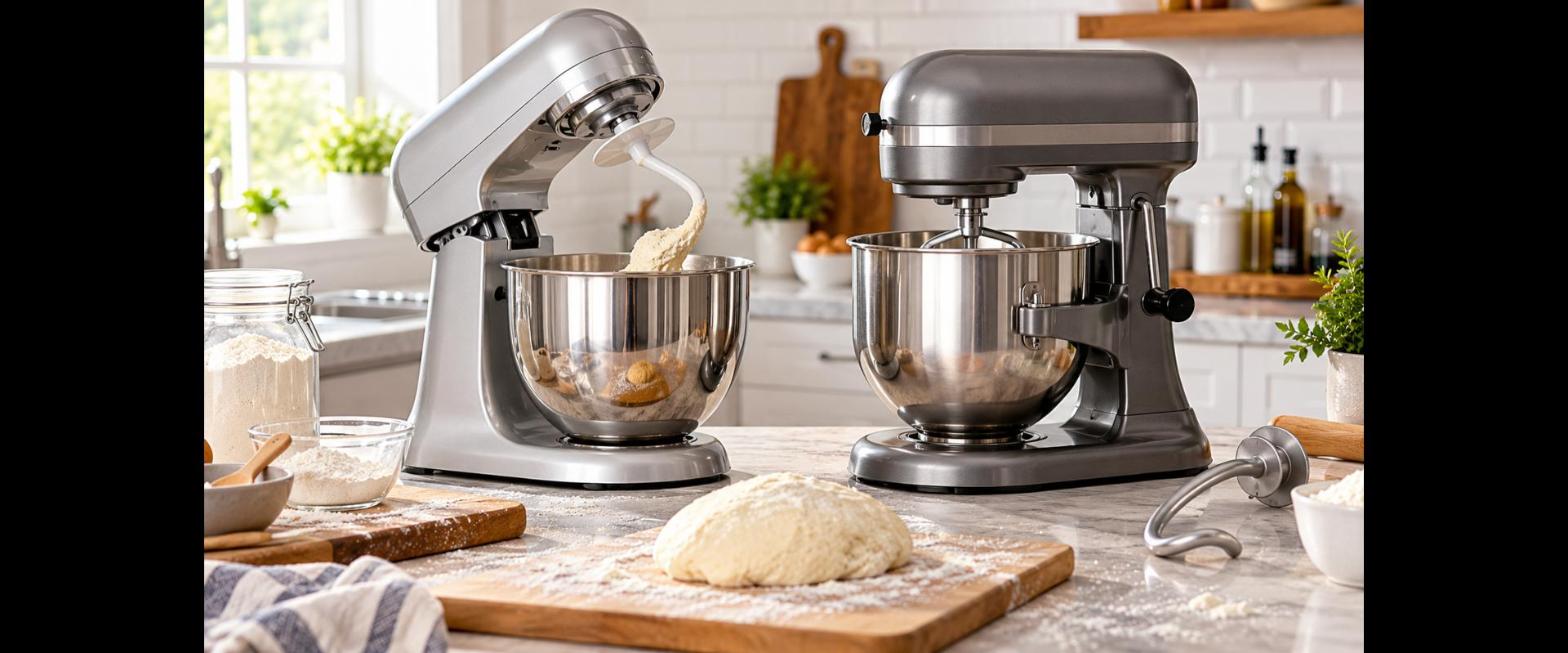
Tilt-head mixers hinge backwards so you can lift the head away from the bowl. Accessing the bowl, swapping attachments and scraping down are all easier. They are lighter, shorter and fit under most wall cabinets. Capacity typically runs from about 4.3 to 5 litres.
Bowl-lift mixers have a fixed head and two arms that raise the bowl into position with a lever. The assembly is more rigid, which matters under heavy load, and these models usually pair with larger motors and bowls of 5.5 to 7 litres. They are heavier and taller, often too tall to sit under a standard wall cabinet.
Motor power and what it means
Quoted wattage is input power and is a poor guide to performance on its own. What actually determines how a mixer handles stiff dough is the gearbox, the motor torque at low speed and the rigidity of the frame. As a practical guide, entry models handle cake batter, cookie dough and whipped cream comfortably; mid-range models manage bread dough in moderate batches; and larger bowl-lift models with higher torque are the ones that take repeated heavy dough work without the head flexing or the motor heating.
If you bake bread weekly, this is the specification that matters most.
Matching capacity to what you bake
- 4.3 to 4.8 litre tilt-head: everyday baking for a household, one or two loaves of bread, standard cake batches. The most common choice and sufficient for most people.
- 5 to 5.5 litre: useful headroom for double batches and larger bread doughs.
- 6 to 7 litre bowl-lift: for frequent large-batch baking, celebration cakes and regular bread making.
Note that a large bowl is worse at small quantities – the whisk may not reach a single egg white properly. If you often whip small amounts, a smaller bowl or a second mini bowl is more useful than extra capacity.
Attachments
Most mixers ship with a flat beater, a wire whisk and a dough hook. Worth knowing:
- Flex-edge or scraper beater – has a flexible edge that scrapes the bowl as it turns. The single most useful upgrade for cake batter and creaming.
- Spiral dough hook on larger models handles stiff dough better than a C-shaped hook.
- Coated versus stainless accessories – stainless is dishwasher safe and does not chip; coated ones can wear.
The attachment hub on the front of most machines accepts pasta rollers, meat grinders, vegetable slicers and more. These are genuinely useful but they are also where the cost adds up quickly – buy them as you need them rather than as a set.
Practical buying points
- Measure the height under your wall cabinets before choosing a bowl-lift model
- Check whether the bowl has a handle – large bowls without one are awkward when full
- Consider weight if the mixer will be stored in a cupboard; many people buy a large machine and never lift it out
- Refurbished and open-box units are common and usually carry a warranty, since these machines are mechanically simple and long-lived
Care
Wipe the collar and hub after use so flour does not set. If the beater scrapes the bowl or leaves an unmixed layer at the bottom, the beater height is adjustable with a single screw – a two-minute fix that most owners never discover. Keep the machine on its lowest speed when adding dry ingredients to avoid clouding the kitchen and straining the motor.
Which to choose
For everyday household baking, a tilt-head of around 4.8 litres with a flex-edge beater covers almost everything and fits under a cabinet. Step up to bowl-lift only if you make bread regularly or bake in large batches – the extra rigidity and torque are the reason to pay more, not the bowl size alone.