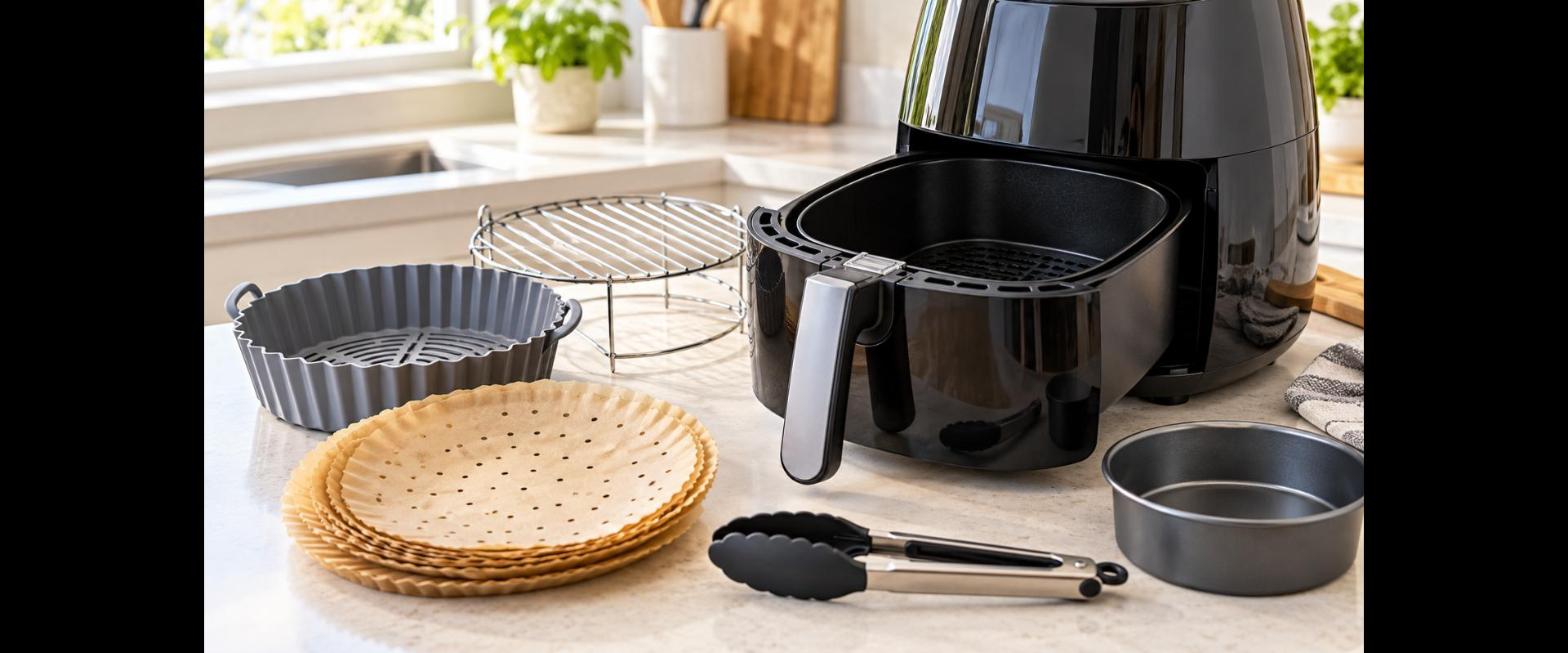
Three accessories earn their place in most kitchens: a silicone or perforated parchment liner, a small oven-safe rack, and a metal cake tin or ramekins that fit the basket. Silicone baskets are safe when they are food-grade and rated for the temperature you cook at: most are rated to 220 to 230°C (428 to 450°F), which covers an air fryer’s usual 200°C (400°F) setting, and they should never touch the heating element. Any cookware marked oven-safe to 230°C, in metal, tempered glass, ceramic or silicone, can go in an air fryer; plastic, wax paper and loose foil cannot.
Check fit before anything else
Basket air fryers and oven-style air fryers need different accessories, and basket sizes vary considerably. Measure the internal diameter or the length and width of your basket, and subtract about 2 cm so air can circulate around the accessory. Anything that fits tightly blocks airflow, which is the entire cooking mechanism.
Worth buying
Perforated parchment liners. The single most useful item. They catch drips, stop marinade welding to the basket, and the holes keep airflow intact. Far better than solid foil, which blocks air and can lift into the heating element. Buy the right shape for your basket.
A silicone liner or basket. Reusable, dishwasher safe and excellent for messy or saucy food. Slightly reduces browning on the base compared with the bare basket, so use it when cleanliness matters more than crispness.
A grill or crisper rack. A raised rack lets you cook a second layer, or lifts food so air reaches underneath. This genuinely increases capacity and improves evenness.
An instant-read thermometer. Not an air fryer accessory as such, but the item that most improves results. Air fryers cook unevenly between models and a thermometer removes the guesswork on chicken and larger cuts.
A small oven-safe dish or cake tin that fits. Opens up eggs, gratins, small cakes and reheating saucy leftovers. A 15 to 18 cm round tin suits most basket models.
Silicone-tipped tongs. Protect the non-stick coating, which is otherwise scratched within weeks by metal tongs.
Occasionally useful
Skewer rack. Good if you cook kebabs often, pointless otherwise.
Silicone muffin cups. Useful for egg bites and portioned baking, and they store flat.
A second basket. On models where it is available, it halves the gap between batches.
Usually not worth it
Rotisserie attachments on basket models – fiddly, hard to clean and rarely used after the first month.
Pizza pans – a solid pan blocks airflow from below, so results are worse than placing the base directly on a rack.
Large accessory bundles – you pay for the two useful pieces and store the rest.
Branded cleaning products – warm water, washing-up liquid and a soft brush handle everything.
Are silicone air fryer baskets safe?
Yes, with three conditions. The liner must be food-grade silicone (look for “FDA” or “LFGB” on the packaging; LFGB is the stricter European test), it must be rated above the temperature you will use, and it must not block the airflow or touch the element. A cheap, strong-smelling liner that is not labelled is the one to avoid, because fillers in low-grade silicone can leach at high heat. A simple check: pinch and twist the silicone; if white shows through, it contains filler. Silicone liners also reduce crisping slightly because they hold moisture under the food, so for chips and anything you want crunchy, use a perforated liner or none at all.
What cookware can be used in an air fryer?
| Material | Safe in an air fryer? | Notes |
|---|---|---|
| Stainless steel, aluminium, carbon steel | Yes | Best for browning. Must fit with 1 to 2 cm of airflow around it. |
| Cast iron | Yes | Heavy; check the basket’s weight limit, usually 2 to 3 kg. |
| Tempered glass (oven-safe, e.g. borosilicate) | Yes, with care | Never put a cold dish into a preheated fryer; thermal shock can crack it. |
| Ceramic and stoneware (oven-safe) | Yes | Heats slowly; add 2 to 3 minutes. |
| Food-grade silicone | Yes | Check the rating, typically 220 to 230°C (428 to 450°F). |
| Parchment paper | Yes, weighted | Only under food; loose paper lifts into the element and can ignite. |
| Aluminium foil | Yes, weighted and away from the element | Not with acidic foods such as tomato or citrus. Check your manual; some makers prohibit it. |
| Wax paper, plastic, melamine, wood | No | Melt, smoke or burn at air fryer temperatures. |
The rule that covers every case: if it is safe in a conventional oven at 230°C, it is safe in an air fryer, provided it physically fits with room for air to move. The guide to cookware materials covers which pans are oven-safe in the first place, and the air fryer buying guide explains how basket size limits what fits.
Materials and safety
Accessories must be rated for the temperature you cook at, typically up to 200 to 230C. Silicone should be food grade and rated above your maximum. Avoid anything lightweight enough to be lifted by the fan into the heating element – this is the most common cause of air fryer damage and includes loose parchment without food on it.
Do not use solid aluminium foil across the base of a basket model. It blocks the airflow the appliance depends on and can cause the unit to overheat.
Cleaning and lifespan
Most accessories claim dishwasher safety, but hand washing extends the life of non-stick surfaces considerably. Never use abrasive pads or metal utensils on coated accessories. Replace perforated liners when they soften, and replace any accessory with flaking coating immediately.
A sensible starter set
Perforated liners, a silicone liner, a raised rack, a small round tin and an instant-read thermometer. That covers the vast majority of cooking, costs less than a typical ten-piece bundle, and every item earns its storage space.
Related guides
- How to Choose an Air Purifier for Your Room
- Best Indoor Plants for Air Quality and Low Light
- Small Kitchen Appliance Essentials: The Realistic List