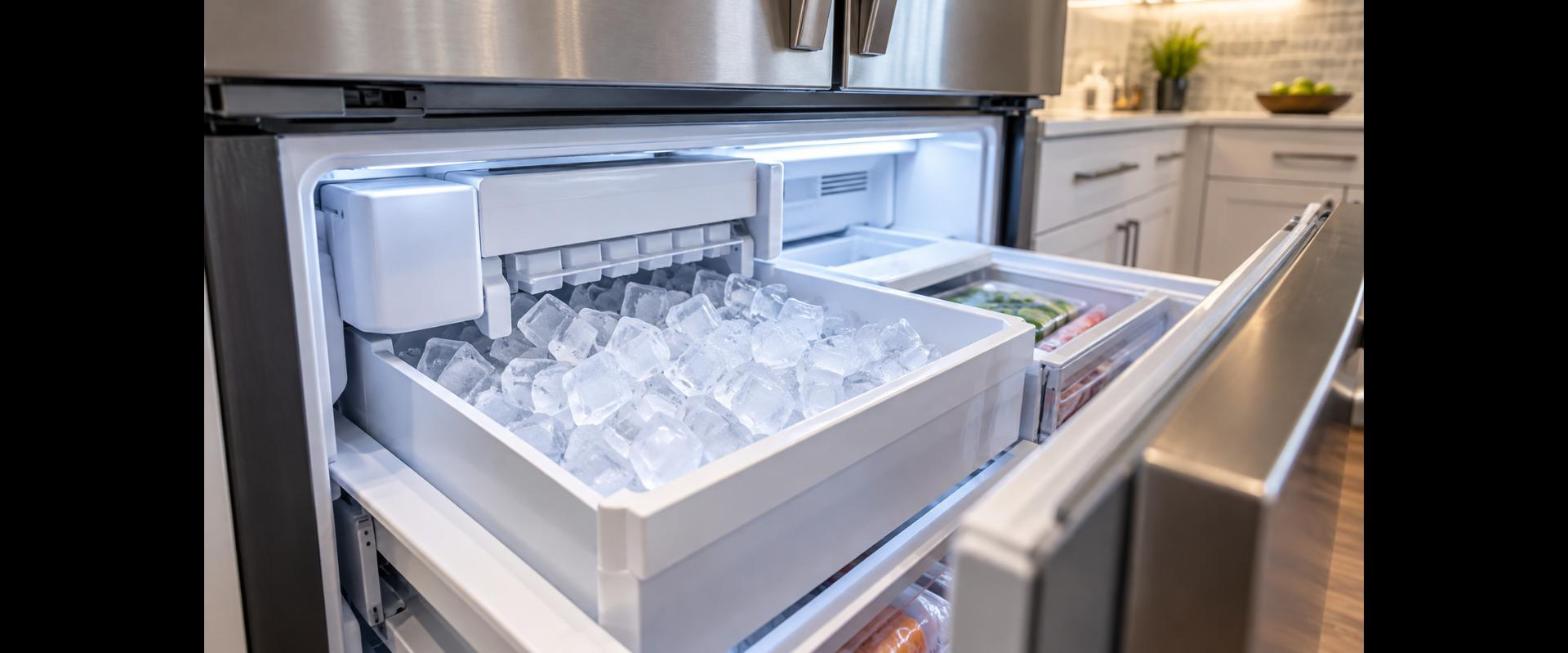
Ice making sits in an awkward place between convenience and complication. A built-in maker is convenient until it fails, and ice makers are among the most serviced parts of any cold appliance. Knowing the options makes the decision easier. Any ice maker needs a supply; see refrigerator water line installation.
The three approaches
Built-in automatic ice maker. A module inside the freezer, plumbed to a cold water line, that fills a mould, freezes it and ejects cubes into a bin. Most produce roughly 1 to 2 kg of ice a day.
Through-the-door dispenser. The same mechanism with a chute and dispenser in the fridge door, usually alongside chilled water. Convenient, but it consumes freezer space and adds the most failure points of any configuration.
Standalone ice maker. A separate countertop or undercounter unit. Countertop models make ice in minutes but do not store it frozen – the ice melts back into the reservoir and is remade. Undercounter machines are plumbed, produce 10 to 25 kg a day and are the right answer if you genuinely need volume.
Plumbed versus manual fill
Plumbed makers connect to a water line and refill automatically. Some chest and upright freezers instead offer a manual-fill reservoir, which you top up by hand – no plumbing, lower cost, but someone has to remember.
If you are plumbing a line, use braided stainless tubing and fit an accessible shut-off valve. Plastic supply tubing is the most common cause of slow leaks behind cold appliances.
What affects production rate
- Freezer temperature. Production slows sharply above about minus 15C. If ice output drops, check the temperature setting before assuming a fault.
- Water pressure. Most makers need at least 1.4 bar, roughly 20 psi. Low pressure gives hollow or undersized cubes.
- Filter condition. A clogged filter restricts flow and is the most common cause of slow ice.
- Door openings. Frequent opening warms the compartment and slows the cycle.
Cube types
Standard crescent or half-moon cubes are what most fridge makers produce. Some premium models add a second maker producing clear, slow-frozen cubes or nugget ice. Nugget ice – soft, chewable pellets – has become popular, and some brands now offer it built in, though it usually commands a significant premium and the mechanism is more complex.
Storage capacity
Check the bin size, not just the daily output. A maker producing 2 kg a day with a 1.5 kg bin will stop once the bin is full, which is fine for everyday use but inadequate for entertaining. If you host regularly, bagging ice in advance or adding a standalone machine is more practical than upgrading the fridge.
Space cost
In a freezer compartment, an ice maker and bin typically consume 10 to 15 per cent of usable volume, and a through-the-door dispenser takes more because the housing intrudes into the door shelves. On a smaller fridge-freezer, that is a real loss. If you rarely use ice, choosing a model without one buys back space and removes a failure point.
Maintenance
- Replace the water filter roughly every six months
- Empty and wash the bin occasionally – ice absorbs freezer odours and old cubes fuse together
- If ice tastes stale, the bin or the water line is usually the cause rather than the maker
- Check the fill tube for frost build-up if cubes come out small or misshapen
- Turn the maker off if the fridge will be unused for a long period
Choosing
For a household using a few trays of ice a week, a built-in maker without a door dispenser is the balance of convenience and reliability. If you entertain often or need large volumes, keep the fridge simple and add an undercounter ice machine. And if you use almost no ice, skipping the feature saves money, saves space and removes the component most likely to need a service call.