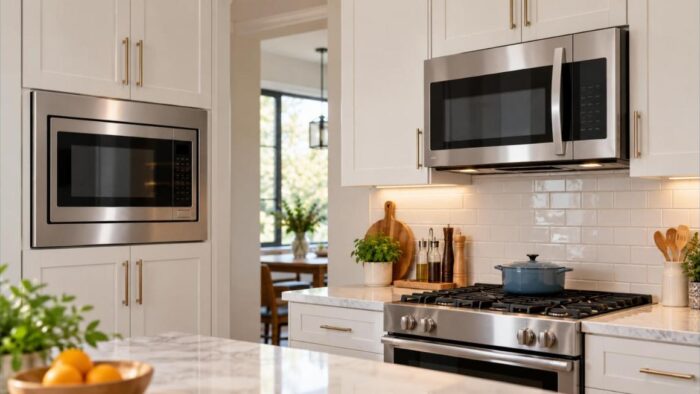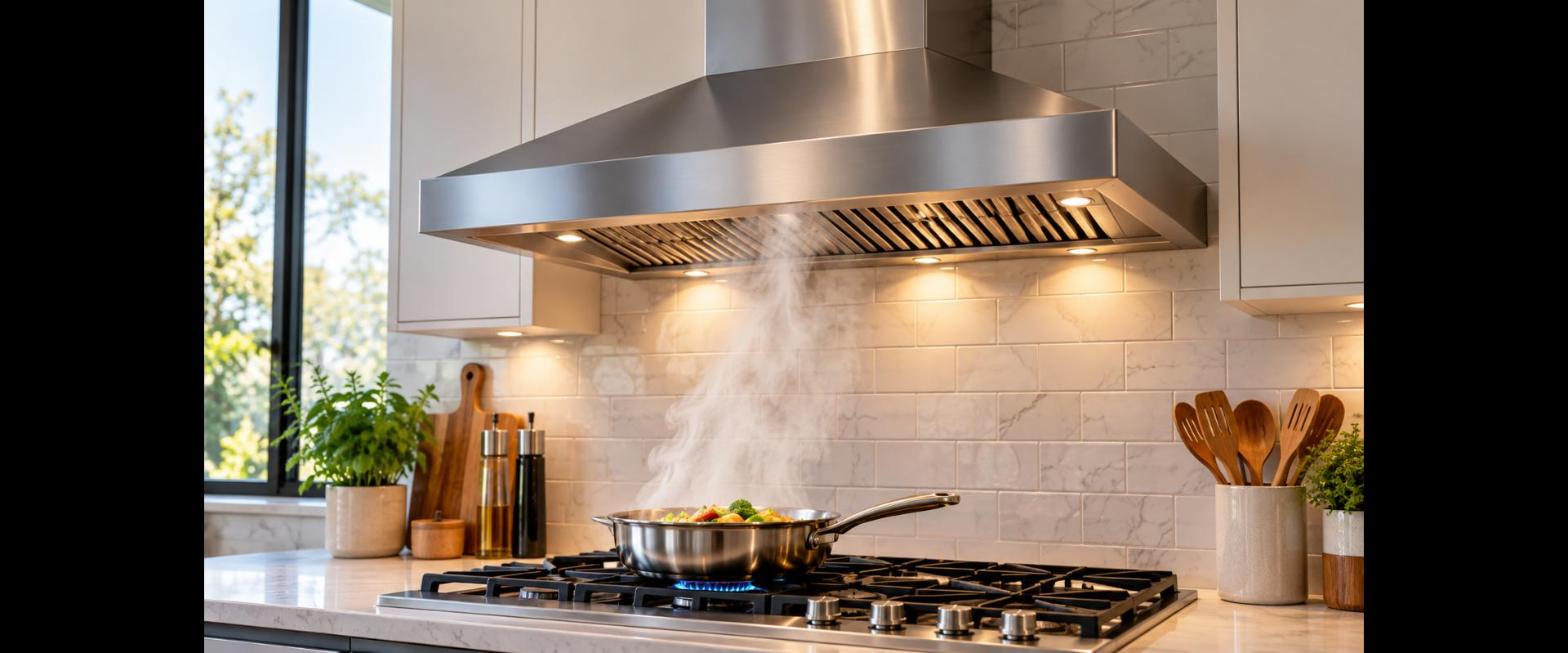
Extraction is the most under-specified appliance in most kitchens. A hood that looks substantial but moves little air leaves grease on cabinets and cooking smells in soft furnishings. The ducted versus ductless choice is the starting point.
Ducted hoods
A ducted hood pulls air through a grease filter and expels it outside through a duct. It removes heat, moisture, grease and combustion products completely. This is the only configuration that genuinely ventilates, and it is the right answer wherever an exterior route is possible.
Requirements: a duct run to an outside wall or roof, ideally short and straight. Every bend and every metre of flexible ducting reduces effective airflow substantially. Use rigid or semi-rigid ducting of the diameter the manufacturer specifies – narrowing from 150 mm to 125 mm to fit an existing hole can cut performance sharply and raise noise.
Ductless, or recirculating, hoods
A recirculating hood passes air through a grease filter and a charcoal filter, then returns it to the room. It removes some odour and some grease. It does not remove heat or moisture, which is a real limitation in a small kitchen and especially with gas cooking.
Charcoal filters need replacing every three to six months depending on use, which is an ongoing cost people forget. Performance degrades steadily as the filter loads.
Recirculating is the right choice only when ducting is impossible – a flat with no external wall near the hob, a listed building, or an island where running a duct would mean major work. Treat it as a compromise, not an equivalent.
Sizing by airflow
Airflow is quoted in cubic metres per hour or cubic feet per minute. Two common sizing approaches:
- By kitchen volume: aim for ten to twelve air changes per hour. Multiply room volume in cubic metres by 10 to 12 for the required m3/h.
- By hob output: for gas, allow roughly 1 CFM per 100 BTU of total burner output. For electric and induction, 10 CFM per linear inch of hob width is a common guide.
Quoted figures are usually measured without ducting. Expect real-world performance to be meaningfully lower, so build in margin rather than buying the minimum.
Size and position
The hood should be at least as wide as the hob, and ideally 8 to 15 cm wider on each side, since cooking plumes spread as they rise. Mount at the height the manufacturer specifies, usually 60 to 75 cm above an electric hob and 65 to 80 cm above gas. Too high and capture collapses; too low and it is a head hazard and a fire risk.
Island hoods need substantially more airflow than wall hoods because there is no wall to help contain the plume, and they suffer badly from cross-draughts.
Noise
Noise rises steeply with airflow. A hood running at full speed above 65 dB will not be used, which makes it useless regardless of its rating. Look at the noise figure at the speed you will actually run, not at the lowest setting. Remote or external blowers, mounted in a loft or on an outside wall, move the motor noise out of the kitchen and are worth considering on high-airflow installations.
Filters
Baffle filters, made of overlapping stainless steel, capture grease well and go in the dishwasher. Mesh filters are cheaper but clog faster and are harder to clean thoroughly. Charcoal filters only appear on recirculating setups and are consumables.
Clean grease filters monthly if you fry often. A clogged filter cuts airflow dramatically and is the most common reason a hood seems to stop working.
Make-up air
Powerful hoods, above roughly 600 CFM, extract enough air to create negative pressure in a tightly sealed home. That can backdraft a flue or a combustion appliance. Many building codes require a make-up air system above a certain extraction rate – check local requirements before specifying a high-output hood.
Choosing
Duct it if you possibly can, size for your hob rather than for looks, choose a model that is tolerable at the speed you will actually use, and keep the filters clean. Those four decisions matter far more than the style of the hood.