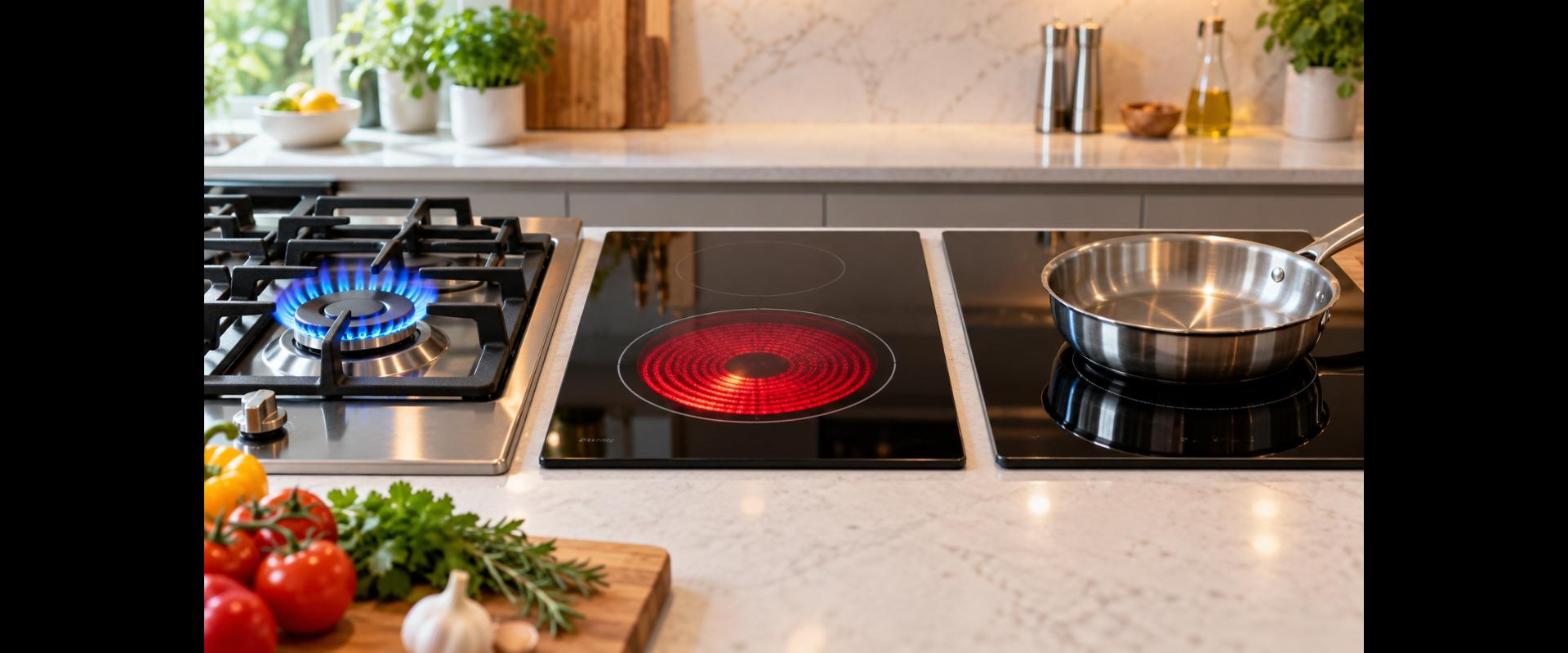
The hob is the appliance you interact with most directly, and the three main technologies behave differently enough that the choice changes how you cook. Here is how gas, radiant electric and induction actually compare.
Speed
Induction wins clearly. It heats the pan itself through a magnetic field, so almost all the energy ends up in the food. A large pan of water typically boils in roughly half the time of gas. Gas is second, and radiant electric is slowest because it has to heat a glass surface which then heats the pan.
Control and responsiveness
Gas and induction are both highly responsive; radiant electric is not. Gas gives a visible flame, which many cooks find easier to judge, and it continues to work during a power cut. Induction responds instantly to a setting change and holds very low temperatures accurately – better than gas for melting chocolate or holding a sauce. Some induction hobs pulse power at the lowest settings, which can be audible.
Efficiency and running cost
Induction delivers roughly 85 to 90 per cent of its energy into the pan, radiant electric around 70 per cent, and gas around 40 per cent, since much of the flame heats the air around the pan. Whether that makes induction cheaper to run depends entirely on local electricity and gas prices – in regions where electricity costs three or four times as much per unit, gas can still be cheaper despite being less efficient. Check your own tariffs before assuming.
Kitchen comfort and air quality
Gas combustion releases heat, moisture and combustion products including nitrogen dioxide into the room, which is why adequate extraction matters with any gas hob. Induction puts very little heat into the kitchen, which is noticeable in summer and in small rooms. Radiant electric sits in between, radiating heat from the glass long after it is switched off.
Cookware requirements
This is the practical catch with induction: pans must be ferromagnetic. If a magnet sticks firmly to the base, it will work. Cast iron, carbon steel and most stainless steel are fine; aluminium, copper and some stainless alloys are not, unless they have a bonded magnetic base. Pans also need a flat base and a reasonable diameter for the zone. Gas and radiant electric accept anything, including woks and warped old favourites.
Cleaning
Induction is the easiest by a distance – the surface is flat glass that stays relatively cool, so spills rarely bake on. Radiant electric is also flat but gets hot enough that spills carbonise. Gas has the most parts: grates, burner caps and crowns all need removing and washing.
Safety
Induction surfaces only heat where a pan sits, and cool quickly once it is removed, which makes them the safest option with small children in the kitchen. Gas has an open flame and a small risk of unlit gas release, although modern hobs include flame failure devices. Radiant electric stays dangerously hot with no visual cue beyond a residual heat indicator.
People with older pacemakers are sometimes advised to keep a distance from induction hobs – worth checking with a cardiologist if that applies.
Installation and cost
Induction needs a dedicated high-amperage circuit, which may mean electrical work in an older home. Gas needs a gas supply and a qualified installer. Radiant electric is usually the simplest and cheapest to fit. On purchase price, radiant electric is the lowest, gas is in the middle, and induction has fallen sharply but still commands a premium at the better end. Add the cost of replacing incompatible pans to any induction quote.
Which to choose
Choose induction if you want the fastest, cleanest and coolest option and your wiring allows it. Choose gas if you cook with woks, want a visible flame, value operation during power cuts, or electricity is expensive where you live. Choose radiant electric if budget is the main constraint or you are replacing like for like without rewiring.
A portable single induction hob is a cheap way to test the technology before committing – a month of using one tells you more than any comparison.