A dishwasher is one of the few appliances you use daily for a decade or more, and the difference between a good purchase and a poor one usually comes down to three things: whether it fits, how quiet it is, and whether the racking suits what you actually wash.
Start with size and fit
Standard full-size dishwashers are 60 cm wide, around 85 cm tall and 60 cm deep, with slimline models at 45 cm. In North America the equivalent is a 24-inch standard and 18-inch compact. Measure the opening in three places – cabinets are rarely perfectly square – and check the height carefully if you have a stone worktop, which cannot be trimmed.
Also measure the door swing and the distance to the opposite cabinet or island. A door that cannot open fully, or that blocks the oven, makes a kitchen miserable to work in.
Built-in, integrated or freestanding
Freestanding units have a finished side and top and can stand alone. Built-under slide beneath a worktop. Semi-integrated hide the body behind a cabinet door but leave the control panel visible. Fully integrated disappear completely, with controls on the top edge of the door. Fully integrated models look cleanest but you cannot see the cycle status without opening the door, so look for one that projects a light onto the floor.
Capacity in place settings
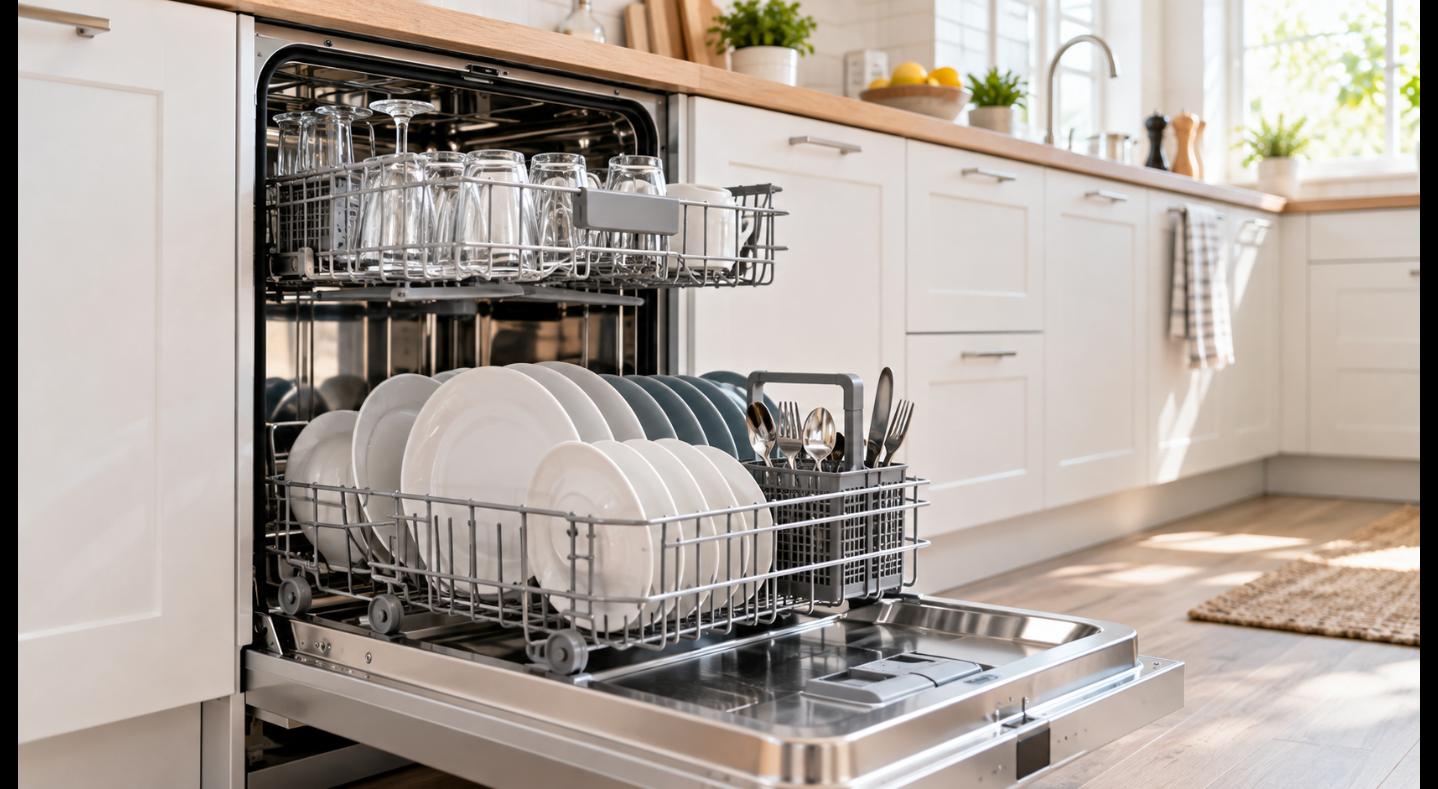
Capacity is quoted in place settings: a full-size machine typically takes 12 to 16, a slimline 9 to 10. A household of two rarely needs more than 12, but larger capacity is useful if you cook a lot or want to run the machine less often. Pay more attention to how the racks are laid out than to the headline number – a 14-setting machine with rigid tines may hold less usable crockery than a 12-setting one with adjustable racking.
Cycles that earn their place
Most machines list ten or more programmes and most people use three. The ones worth having:
- Eco – the longest cycle but the lowest energy and water use, and the one the official energy rating is measured on. It is the correct default for everyday loads.
- Auto – uses a turbidity sensor to judge how dirty the water is and adjusts accordingly. Genuinely useful on mixed loads.
- Intensive – higher temperature for pans and baked-on food.
- Quick – 30 to 60 minutes for lightly soiled items, at a cost in energy and water.
- Half load or zone wash – washes only the upper or lower basket.
Steam pre-soak, glass care and sanitise cycles are nice extras, not reasons to pay a large premium.
Noise matters more than the spec sheet suggests
Noise is measured in decibels. Above 48 dB is noticeable in an open-plan room; 44 to 46 dB is normal for mid-range machines; below 42 dB is genuinely quiet and you will often only hear the water. Because the decibel scale is logarithmic, a 6 dB drop is a substantial difference in perceived loudness. If your kitchen opens onto a living area, this is the single feature most worth paying for.
Racking and loading flexibility
Look for height-adjustable upper baskets, foldable tines in both baskets, and a cutlery tray or third rack at the top. Removable or adjustable tine rows let you fit mixing bowls, baking trays and oddly shaped items that otherwise defeat a rigid layout. Open the baskets in the showroom and try moving things – this tells you more in two minutes than any brochure.
Drying systems
Condensation drying is standard and energy efficient but leaves plastics damp. Heated drying dries thoroughly and uses more power. Zeolite drying, found on some European models, uses a mineral that releases heat as it absorbs moisture and dries very well with modest energy use. Auto door opening at the end of the cycle is a simple and effective addition on many mid-range machines.
Energy and water use
Modern machines use roughly 9 to 12 litres per eco cycle, far less than washing by hand under a running tap. Compare the annual energy figure on the label rather than the letter grade alone, since grading scales have been rescaled in recent years.
Features that are often oversold
Wi-Fi connectivity is useful mainly for cycle-finished alerts and remote start on a cheap-rate tariff. Internal cameras, voice control and dozens of niche programmes rarely change daily use. Spend the budget on quietness, racking quality and a reliable brand instead.
Before you buy
Confirm your plumbing: most machines need a cold feed, a waste connection and a dedicated socket, all within about 1.5 metres. Check whether installation and old-appliance removal are included. And look at the warranty – some brands offer five or ten years on the motor and tub, which is a reasonable signal of expected life.